AFC Qualifiers – Asian powerhouses see first action as group stages begin

We’re back after a month with much of action, both in Asia and Africa. Whereas in Africa the preliminary round has taken place over the week, the first two matchdays of the Asian qualifiers – that is of the group stages of the second round – will be the point of attention today. The African qualifiers will be discussed at a later time along with a preview on the group stages of the second round to be drawn at a later stage this year as the first games will only be played in March next year.

So, looking at Asia, the first two matchdays – all played on the 5th and 10th of September – have now been completed. This however doesn’t mean that every country has played two games as of now, because the groups are divided over an odd number of teams (five), which means that there will be a total of twelve matchdays until we’ll know who proceeds to the next phase, to have a chance at ultimately reaching the FIFA World Cup to be played in Qatar in 2022. Nevertheless, all of the remaining nations that are still eligible to qualify for the World Cup have at least played one qualifying match, so we’ll have an idea on how they’re going to perform during this campaign. Most of them also played a friendly match during the international break, which might be interesting to take a look at. I’ll discuss the groups individually, looking at the different games played over the week. I won’t describe them all in detail, but I’ll pick the most noticeable matches, either because of the teams involved or the turn of events that took place that are of any interest.

Group A (China, Guam, Maldives, Philippines, Syria)

The first game of this second round saw the small island nation Guam – located in the Pacific Ocean – host another island nation, namely that of the Maldives, which is located in the Indian Ocean. Guam – second lowest ranked nation on the FIFA World Ranking (190th) – impressed in their home game in the preliminary round a few months ago, disposing Bhutan by 5-0, which led them qualify for the second round for the second time in their history. In front of a mere 700 people, Guam couldn’t repeat their winning home form, due to a 27th-minute goal by Maldivian striker Mahudhee, which turned out to be the only goal, giving the Maldives the first three points of the group stages. Although the home team seemed to create some chances, they were unable to worry the Maldives national team, who hadn’t won in almost a year, when they beat India at home. The Maldives also had a disappointing campaign in the Indian Ocean Island Games played over the summer this year, where they lost all three games quite convincingly.

A few days later, Maldives had the chance to add to their good start, although a visit by the Chinese national team was never going to turn out an easy task to keep some points on the island. In the Maldives then, China breezed to victory, beating them 5-0. ‘Team Dragon’ – coached by Italian legend Marcello Lippi who led Italy to the 2006 FIFA World Cup trophy – took some thirty minutes to find the first goal, but then didn’t look back. Brazilian born Elkeson was able to score twice in the late stages of the game (one by converting a penalty). The player of Chinese giants Guangzhou Evergrande – now coached by Fabio Cannavaro – made his debut, meaning that he has a scoring record of two per game as of now. Lippi resigned earlier this year after a disappointing Asian Cup and was replaced by another Italian legend – who was part of that succesful 2006 team – Fabio Cannavaro. However, Lippi was reappointed in May. China has played only one game yet in qualifying, but they did play a friendly game against Myanmar about two weeks ago, which also resulted in a comfortable win; 4-1.

Guam also had a chance to redeem itself against the Philippines, again at home at the Guam FA National Training Center in Dededo, but the Azkal (which translates to Street Dogs) proved to be a much better side as is also displayed on the FIFA World Ranking as they triumphed on the small island of Guam; 1-4. The Philippines were able to take a quick 2-0 lead after 12 minutes, until Guam-born Marcus Lopez scored a penalty in 67th minute to make the game seemingly more exciting. However, only four minutes later regained an advantage of two, and was able to score a fourth in the closing minutes. Interestingly, all Filipino goals were scored by four individual foreign-born players, three of which were born in Germany.

The Philippines needed the goals however, after an earlier home defeat on the first matchday to Syria. Syria, expected to compete with China for that first spot in the group, came from behind however, after the home team took the lead in the 6th minute after a header of another foreign-born (Spanish) Filipino player Javier Patiño. A few minutes later Syrian striker Omar Al Somah equalised with a beautiful header towards the top corner. The go-ahead goal for Syria fell in the 30th minute with a great strike by Khaled Mobayed, hitting the top of the netting after a powerful shot. After a converted Syrian penalty early in the second half, Al Somah would find his second goal of the game, again after a strong header. Al Somah, who plays for Al-Ahli in Saudi Arabia where he roughly has a one-on-one goal scoring record in the Saudi Premier League over the past five seasons, has now scored ten times after 22 appearances. Both teams were able to score another goal each in the final ten minutes of the game, making the score 2-5 in total. Syria, who surprisingly didn’t win any of the four games (2 draws, 2 losses) during the West Asian Football Federation (WAFF) Championship in August and also didn’t impress during the AFC Asian Cup in January (1 draw, 2 losses), has started their qualifying campaign well after this win and will look with confidence towards their confrontations with China come November and June.

Group A results:
5 sep. Guam 0-1 Maldives
5 sep. Philippines 2-5 Syria
10 sep. Guam 1-4 Philippines
10 sep. Maldives 0-5 China

Standings:
Team             GP  W-D-L  GF-GA  GD PTS
China            1   1-0-0   5-0   +5   3
Syria            1   1-0-0   5-2   +3   3
Philippines      2   1-0-1   6-6    0   3
Maldives         2   1-0-1   1-5   -4   3
Guam             2   0-0-2   1-5   -4   0

Group B (Australia, Jordan, Kuwait, Nepal, Taiwan)

The Taipei Municipal Stadium was host to the first game in Group B between Taiwan – registered as Chinese Taipei – and Jordan. In a group where Australia is likely to dominate, Jordan would be the foremost team to claim that second spot. This would imply that they can’t drop too many points, especially against the weaker sides, since only the four best second-ranked teams qualify to the second round. A long journey to the island of Taiwan would prove to be a big first hurdle during their campaign as they scraped out a small victory in front of close to 6,000 spectators; 1-2. The first goal for ‘The Chivalrous’ was scored in the 19th minute by Baha’ Faisal after Taiwanese goalkeeper Pan When-chiech failed to keep hold of the ball. A second goal was kicked in by Ahmed Samir after the same goalkeeper pushed the ball out quite unconvincingly. Wen Chih-hao scored the 1-2, but it turned out to be too late for them.

Five days later, the same stadium was host to the second qualifying match for Taiwan, this time against the highlanders of Nepal, who hadn’t won a game in about a year and lost the opening game of the group stage 7-0 to Kuwait. In Kuwait City, the relatively small oil-rich nation had little issues with the Nepalese, who are obviously more used to the heights of the Himalayas than the desserts in Eastern Arabia at sea-level. Yousef Nasser scored the opening goal early in the game (6th minute) and would later add a second to his tally when scoring the 3-0. ‘The Blue Wave’ would add another two before the 90th minute and two more in extra time, ensuring the largest margin of victory during the first two matchdays of Asian qualifiers. Taiwan and Nepal had met a couple of months earlier, in June, when they played a friendly, also in Taiwan, which ended 1-1. An indirect free kick elevated the Nepalese spirits when it was headed in by 21-year old Anjan Bista, who already had 30 caps on his name, after he debuted in 2014 at the age of 16 for the national squad, though this was only his first goal. Taiwan then had the better chances, especially when they themselves almost converted an indirect free kick just on the brink of halftime, but the header by Chen Jui-chieh, but his header went just wide. In the second half however, a good shot from the edge of the box by Bista, would double Nepal’s lead as well as Bista’s goal production for his country, and secured a surprising Nepal win, as ‘The Amkhalis’ were clear underdogs, ranked 40 places below Taiwan on the FIFA World Ranking.

Also Kuwait played their second home game after their sensational 7-0 win earlier, but this time their opponent was from a completely different caliber; Australia. In front of 12,000, it was clear that both sides weren’t equally matches, as ‘The Socceroos’ grabbed a 2-0 lead only after 30 minutes, after two corners were both tapped in by Mathew Leckie, who currently plays at Hertha BSC in Germany. A few minutes later, Brighton & Hove Albion midfielder Aaron Mooy scored the third goal, a nicely placed strike in the top corner from outside the sixteen. ‘The Blue Wave’, also playing in their traditional blue, created a couple of chances in the second half, but Australia’s win was already a certainty as it ended 0-3. Despite only playing one qualifier this week, Australia didn’t play a friendly match, whereas Jordan played Paraguay; 2-4.

Group B results:
5 sep.  Taiwan 1-2 Jordan
5 sep.  Kuwait 7-0 Nepal
10 sep. Taiwan 0-2 Nepal
10 sep. Kuwait 0-3 Australia

Standings:
Team             GP  W-D-L  GF-GA  GD PTS
Kuwait            2  1-0-1   7-3   +4   3
Australia         1  1-0-0   3-0   +3   3
Jordan            1  1-0-0   2-1   +1   3
Nepal             2  1-0-1   2-7   -5   3
Taiwan            2  0-0-2   1-4   -3   0

Group C (Bahrain, Cambodja, Hong Kong, Iran, Iraq)

In a 45,000 packed Olympic Stadium in Phnom Penh, Cambodia played their first match against of the secound round – after beating Pakistan in the preliminary round -against Hong Kong (formally a special administrative region of China). The battle between the two lowest ranked teams of Group C ended in a 1-1 draw after Hong Kong came in front in the 16th minute after a great run by Tan Chun Lok, who remained calm and put the visitors ahead. Keo Sokpheng made the equalizer before half time, and despite a dangerous shot by Chhin Chhoeun in the second half, which hit the post, both teams took one point home. ‘The Angkor Warriors’ – currently managed by Keisuke Honda and Félix Dalmás – are still on the up however, since they lost twice during their last FIFA World Cup qualifying campaign to the same Hong Kong side.

On Tuesday then, the Olympic stadium held another 45,000 fans when facing Bahrain. Bahrain – the oil-rich island in the Persian Gulf – who should be able to compete with Iraq for the second spot behind Iran, after drawing also 1-1 during matchday 1 when a late goal by Iraqi striker Mohanad Ali made sure that Iraq earned their point on the island of Bahrain. The most noticeable player during that game was Iraqi goalkeeper Mohammed Hameed who made a horrendous blunder in the sixth minute of the game, when a shot from distance by Kamil Al Aswad went straight through the goalkeeper’s arms. Hameed recovered during the game and made some great saves later on. His resilience was thus rewarded with the late equalizer. The Cambodians then, in front of their extravagant crowd, clearly struggled to keep Bahrain from scoring, as the away side had the clear upperhand during much of the game. However, as a result of great defensive interceptions and good goalkeeping by Keo Soksela, it took 78 minutes until Bahrain was finally able to score, when the Cambodian defense was unable to clear the ball after a corner kick and was tapped in by Kamil Al Aswad who scored his second goal in two qualifying matches. Iraq would get another 1-1 result later in the week when they drew against Uzbekistan in a friendly.

Hong Kong played their second game at home – in front of a 14,000 people crowd – against group favourites Iran. ‘Team Melli’ had an easy day out as they had plenty of chances during the first half. Sardar Azmoun – striker for Zenit St. Petersburg in Russia – scored his 29th international goal in the 23th minute. A few minutes later, Karim Ansarifard hit the cross bar when he attempted a bicycle kick. The former striker of among which Greek giants Olympiacos, would later get his goal after a regular tap in, setting the score at 0-2.

Group C results:
5 sep.  Cambodia 1-1 Hong Kong
5 sep.  Bahrain 1-1 Iraq
10 sep. Cambodia 0-1 Bahrain
10 sep. Hong Kong 0-2 Iran

Standings:
Team             GP  W-D-L  GF-GA  GD PTS
Bahrain           2  1-1-0   2-1   +1   4
Iran              1  1-0-0   2-0   +2   3
Iraq              1  0-1-0   1-1    0   1
Cambodia          2  0-1-1   1-2   -1   1
Hong Kong         2  0-1-1   1-3   -2   1

Group D (Palestine, Saudi Arabia, Singapore, Uzbekistan, Yemen)

The modern 55,000 capacity National Stadium in Singapore was host of the qualifier between Singapore and Yemen. It ended in 2-2, although Yemen led the game by 2-1 at the break. The equalizer was well-deserved for ‘The Lions’ who dominated the first half, but were impeded by Yemeni goalkeeper Salem Saeed and a couple of offside situations. The same scoreline was applicable for the Yemen game a few days later, when they faced neighbours Saudi Arabia. It was to be a tough game for the ‘The Red Devils’ as they hadn’t won a single game out of their past five meetings with ‘The Green Falcons’, also without scoring a single goal. To further complicate things, the match was played in Bahrain, at the National Stadium, possibly due to the ongoing war in Yemen, in which the Saudis are heavily involved in. I couldn’t find a definitive explanation for this change however. The ‘home team’ then took the lead in eighth minute by arguably the best goal so far in qualifying, a beautiful bicycle kick by Mohsen Qarawi, which just looped over the Saudi Arabian goalkeeper and found the net. It was only Yemens’ second goal ever against the greens of Saudi Arabia in history of any FIFA sanctioned match. After Saudi Arabia equalized in the 22nd minute, Yemen once again retook the lead still in the first half. Early in the second half, Salem Al-Dawsari put away another equalizer, which would turn out to be the final score; 2-2. It was Saudi Arabians second draw of the week after playing 1-1 earlier in the week against African side Mali. Early point drops then for the favourites in this group, but with some tough opposition to face in Palestine and Uzbekistan most notably.

Speaking of those two, they faced each other for their first match on the 5th of September, in Al-Ram, which lies in Palestinian Territory – not officially recognized by all United Nations members – just north of Jerusalem. ‘The Lions of Canaan’ scored twice in the second half to secure a surprising win against the Uzbeks, who are ranked eighteen places above Palestine on the FIFA World Ranking. In their previous three meetings, Uzbekistan also won on all three occasions, without conceding a goal. Palestine were however unable to continue their strong start after traveling to Singapore, who had drawn their match against Yemen. After only three minutes, ‘The Lions’ found their first goal after some poor defending by the possibly jet-lagged Palestinians, which was exploited by Singaporese defender Shakir Hamzah. Despite being overwhelmed in the first stages of the match, Palestine did redeem themselves quickly with a goal by Yaser Hamed in the 13th minute. A close match followed until a header by Safuwan Baharudin from a corner kick. The second half would turn out to be unfriendly, mostly as a result of frustrations from the away side. Although Palestine had the upperhand in the second half, Singapore was able to hold on to their lead, which resulted in a surprising win for the home country; 2-1.

Group D results:
5 sep.  Singapore 2-2 Yemen
5 sep.  Palestine 2-0 Uzbekistan
10 sep. Singapore 2-1 Palestine
10 sep. Yemen 2-2 Saudi Arabia

Standings:
Team             GP  W-D-L  GF-GA  GD PTS
Singapore         2  1-1-0   4-3   +1   4
Palestine         2  1-0-1   3-2   +1   3
Yemen             2  0-2-0   4-4    0   2
Saudi Arabia      1  0-1-0   2-2    0   1
Uzbekistan        1  0-0-1   0-2   -2   0

Group E (Afghanistan, Bangladesh, India, Oman, Qatar)

In Group E, we witnessed the first official FIFA World Cup qualifying by an already qualified team as Qatar faced Afghanistan on the grounds also to be used during the eventual tournament. Although the stadium itself – the 15,000 seater Jassim bin Hamad Stadium in Doha – will not be used itself during the world cup, as many of the actual venues are under construction, it does provide a sense of the vibe of a world cup being hosted in Qatar. The stadium was filled by about 70 percent of its total capacity – commonly by men wearing typically white garb – creating quite an intimate atmosphere as the Qatar national team – who won the Asian Cup earlier this year – trumped the Afghanis quite confidently as The Maroons put six goals away. The goals seemed to come quite easy as the Afghani defense were unable to challenge the Qatari attackers. In the tenth minute Sudanese-born striker Almoez Ali already scored his second goal and he would add a third in the beginning of the second half to complete his hat-trick, which means he now has goalscoring record of exactly 0.5 per game as he has scored 23 goals in 46 matches, only at the age of 23. The score could’ve been much higher hadn’t it been for some great saves made by Ovays Azizi. Still the 6-0 win by Qatar is a great start in preparation for its first world cup appearance to be played in a little over three years in front of the home crowd.

Five days later however, the Qataris disappointed against India, playing in the same arena as the game against Afghanistan, as it turned out to be a goalless affair. Although Qatar were still the dominant side in the game, India did get some chances towards the end of the game to really upset the crowd, but in the end both teams were unable to convert any of their chances. India had lost to Oman about a week earlier in front of a 20,000+ crowd in Guwahati when Oman striker Al-Alawi singlehandedly brought his team back from behind in the final ten minutes of the game by two extraordinary finishes. Especially Al-Alawi’s strike in 89th minute from the edge of the sixteen which ended top corner was beautiful and put the Indians in awe.

Lastly, Afghanistan managed to regain some of its confidence by beating Bangladesh; 1-0. The game was played in Tajikistan in front of a crowd of around 5,000 due to security issues concerning the ongoing war in Afghanistan. The winning goal was scored by former PSV Eindhoven and Dutch youth team player Farshad Noor, who currently plays at Nea Salamis Famagusta in Cyprus.

Group E results:
5 sep.  India 1-2 Oman
5 sep.  Qatar 6-0 Afghanistan
10 sep. Afghanistan 1-0 Bangladesh
10 sep. Qatar 0-0 India

Standings:
Team             GP  W-D-L  GF-GA  GD PTS
Qatar             2  1-1-0   6-0   +6   4
Oman              1  1-0-0   2-1   +1   3
Afghanistan       2  1-0-1   1-6   -5   3
India             2  0-1-1   1-2   -1   1
Bangladesh        1  0-0-1   0-1   -1   0

Group F (Japan, Kyrgyzstan, Mongolia, Myanmar, Tajikistan)

This group started in Ulaanbaatar, Mongolia, similarly to the first round qualifiers. Mongolia faced Myanmar, two teams destined to fight for avoiding last place in this group. In this battle, Mongolia now pulls the strings as it was able to put one away whilst conceding no goals; 1-0. The only goal was scored by 18-year old Dölgöön Amaraa as the young defender – a former Puskás academy player – scored his first international goal for Mongolia in only his second performance.

Mongolia faced much tougher competition a few days later when hosting Tajikistan who are expected to battle with bitter rivals Kyrgystan for that second place in the group, which grants access to the next qualifying stages. For that matter, Tajikistan already had taken a great first step when they beat the Kyrgyzstani a few days earlier in front of a electric home crowd of 18,000 people, who saw the winning goal being scored in the 41st minute by former Russian youth international Alisher Dzhalikov who placed the ball in the bottom corner. In their away tie against Mongolia, the single deciding goal fell quite a bit later on in the match, headed in by Tajik defender Davronjon Ergashev in the 81st minute.

It was then the turn of Samurai Blue (Japan) to prove themselves as the favourites to end on top. A tough away match awaited them in Saigon in Myanmar, where the Thuwunna Stadium was nicely filled by more than 25,000 people. In the monsoon rains in Myanmar, Japan intended to finish up shop as soon as possible. A nice shot from the edge of the sixteen by Shoya Nakajima which curled in the far corner, by which the score was opened after only fifteen minutes of play. Ten minutes later, it was Red Bull Salzburg’s striker Takumi Minamino’s turn when he converted a header assisted by new PSV signing Ritsu Doan, who saw his first attempt on goal saved by the Myanma goalkeeper. A few moments later, Myanmar fortunately escaped a third goal when a Japanese header was cleared off the goalline before headed onto the bar by Japanese captain Maya Yoshida. The Samurais seemed satisfied with the first two goals as they played the game out without any more goals being scored during the game.

Group F results:
5 sep.  Mongolia 1-0 Myanmar
5 sep.  Tajikistan 1-0 Kyrgyzstan
10 sep. Mongolia 0-1 Tajikistan
10 sep. Myanmar 0-2 Japan

Standings:
Team             GP  W-D-L  GF-GA  GD PTS
Tajikistan        2  2-0-0   2-0   +2   6
Japan             1  1-0-0   2-0   +2   3
Mongolia          2  1-0-1   1-1   0    3
Kyrgyzstan        1  0-0-1   0-1   -1   0
Myanmar           2  0-0-2   0-3   -3   0

Group G (Indonesia, Malaysia, Thailand, United Arab Emirates, Vietnam)

Beforehand, one of the most interesting groups, consisting of four South East Asian countries and the United Arab Emirates, who last qualified for the FIFA World Cup in 1990 and were the hosts of the AFC Asian Cup in January of this year. The first game, played in Thamassat Stadium on the edge of Bangkok, saw Thailand facing Vietnam. Both teams met just a few months earlier as part of the Kings’ Cup 2019, which was played in Thailand, when the Fire-Drake Warrior (i.e. Vietnam) won 1-0. This day however both teams were unable to score in front of a 20,000 audience. Thailand seemed to create the best chances, especially through number 7, the 21-year old Supachok Sarachat, but remained scoreless nonetheless.

The War Elephants were however able to grab all three points on their away trip to the Gelora Bung Kamo Stadium in Jakarta, Indonesia, when they easily disposed the Indonesians 3-0. Once again, star of the show was Supachok Sarachat, who managed to score a brace – his first international goals for Thailand – the first one scoring in the 55th minute when it was still even. His strike from just outside the sixteen was well-placed in the bottom corner and left Indonesian goalkeeper Andritani Ardhiyasa. The other goal was scored by Theerathon Bunmathan from the penalty spot. The 77,000 capacity stadium was only filled by about 11,000 spectators, a stark difference compared to a few days earlier when Indonesia faced its neighbouring rivals, the tigers of Malaysia. Played in the same stadium, almost 55,000 people went to see the numbers 160 vs. 159 of the world based on FIFA’s ranking. Arguably the most attractive fixture from this week, the match itself didn’t fail to live up to those expectations.

The home crowd were delighted when Brazilian-born Indonesia striker Beto Gonçalves passed the Malaysian goalkeeper, as the latter only saw the ball in the net after it went through his legs. The equalizer was then scored about ten minutes before halftime after a clean finish again by a foreign-born player, namely the Gambian-born Mohamadou Sumareh. Only two minutes it was the 38-year old striker Beto again who lifted the crowd, now scoring his tenth international goal for Indonesia, after only making his debut less than a year ago. The striker – who spent most of his time in his birthcountry Brazil and current residence Indonesia – has as of now played for merely twenty different clubs, including Penang FA from Malaysia. A header by Syafiq Ahmad again equalized the score in the second half, after a corner for the Tigers wasn’t adequately dealt with by the Red and White’s defense. The home crowd was then left shocked when Sumareh tapped in his second goal in the 96th minute, an incredibly crucial winner for the Malaysians in their qualifying campaign.

Malaysia tried to build upon their great start a few days later when they met with the group’s favourites to go through, the United Arab Emirates (UAE). The Tigers – playing in their usual black and yellow – got off to a great start by scoring in the first minute, again through a header by Syafiq Ahmad, scoring his second goal during the qualifying campaign. The more than 40,000 spectators were optimistic that Malaysia were to get their second three-pointer until UAE’s Ali Mabkhout who’s looking to become the country’s all time topscorer, as he also scored the second and deciding goal today and now just needs one goal to tie with Adnan Al Talyani – who retired from international football in 1997. He does have to keep his fellow striking partner Ahmed Khalil from scoring as they now both have 51 goals on their tally. Although Malaysia’s late loss was disappointing, which was the same result as when they met for the 2018 FIFA World Cup qualifiers back in 2015, it was nowhere as demoralizing as the 10-0 defeat to UAE earlier during that campaign when played in the Arab nation, when the Mabkhout-Khalil strike force was responsible of seven of those goals.

Group G results:
5 sep.  Thailand 0-0 Vietnam
5 sep.  Indonesia 2-3 Malaysia
10 sep. Indonesia 0-3 Thailand
10 sep. Malaysia 1-2 UAE

Standings:
Team             GP  W-D-L  GF-GA  GD PTS
Thailand          2  1-1-0   3-0   +3   4
UAE               1  1-0-0   2-1   +1   3
Malaysia          2  1-0-1   4-4    0   3
Vietnam           1  0-1-0   0-0    0   1
Indonesia         2  0-0-2   2-6   -4   0

Group H (Lebanon, North Korea, South Korea, Sri Lanka, Turmenistan)

In Group H, where most of the attention naturally draws towards the Korean rivalry, the North Koreans were the first side to kick off against Lebanon. In a packed Kim-Il Sung Stadium in Pyeongyang (40,000 were in attendance), it was Korean striker Jong-Il Kwan, currently unattached to any club, but one of few North Koreans to have played outside the country, having played at FC Luzern and FC Wil in Switzerland, managed to make the difference by scoring two goals and leading his country to its first win. His second goal was an thundering strike in the top corner, which left the Lebanese goalkeeper absolutely without a chance to save it. North Korea then took on the island nation of Sri Lanka, who are ranked lowest of the current nations to be part of the group stages (200th). Sri Lanka’s qualification for the second round was entangled with quite some controversy featuring its opponent, Macau, in the preliminary qualifying round refusing to travel to Sri Lanka due to recent terrorist activity. FIFA eventually responded by expelling Macau, who had won their first tie of the two-legged affair, leading to automatic qualification of Sri Lanka. North Korea struggled to find the winner, but eventually did score just the one goal in the 67th minute by centre-back Jang Kuk-chol.

It was Sri Lanka’s second hosting during the group stages, as they faced Turkmenistan a few days before. The Turkmeni’s had less trouble with the Golden Lion as they managed to score their first goal already in the 8th minute by Wahit Orazsähedow. A later goal by Arslanmyrat Amanow – who plays for the largest club in Turkmeni football in Lokomotiv Tashkent – sealed the deal and left Sri Lanka after two games – both played in front of a mere 1,000 crowd – pointless and goalless. They’ll have to face some tough challenges when they’ll be traveling away to the big guns in the group. It was then Turkmenistan’s turn to start the qualifying campaign for South Korea. Obvious favourites to win the group, The Karakum Warriors playing in front of a 26,000 crowd in Köpetdag Stadium in Ashgabat, couldn’t pose a real threat for the South Koreans – captained by Son Heung-min as it ended 0-2. The goalscorers were Na Sang-ho and Jung Woo-young – the latter playing at Al-Sadd in the future World Cup hosting country of Qatar.

Group H results:
5 sep.  North Korea 2-0 Lebanon
5 sep.  Sri Lanka 0-2 Turkmenistan
10 sep. Turkmenistan 0-2 South Korea
10 sep. Sri Lanka 0-1 North Korea

Standings:
Team             GP  W-D-L  GF-GA  GD PTS
North Korea       2  2-0-0   3-0   +3   6
South Korea       1  1-0-0   2-0   +2   3
Turkmenistan      2  1-0-1   2-2    0   3
Lebanon           1  0-0-1   0-2   -2   0
Sri Lanka         2  0-0-2   0-3   -3   0

So that’s it, the first 32 matches of the group stages have been played and no big surprises as of yet I would say. I’m posting this about a month late due to the amount of matches to cover and busyness in life, but I’ll try to update the blog sooner in the future. The third and fourth matchdays has also already taken place last week. I’ll move the discussion on Africa’s qualification towards early next year until the full qualification – the group stages – will get underway. Until then, I’ll mostly focus on Asian football. So thanks for your patience and thanks for reading my posts 😉

AFC Qualifiers – An overdue look at the second round draw.

Although the Asian qualifiers got underway today, I would like to take the time today to look at the draw for the second round. This post will focus solely on the AFC qualifiers, although they have also started up in Africa as well. However, those first round matches have been spread over the next couple of days, which consists of a knock-out round played over two legs (home and away) featuring the 28 lowest ranked nations of the African continent based on the FIFA World Ranking. Therefore a later post will cover all of the action from Africa. I do want to point out that all of these matches in round 1 of the African qualifiers are broadcasted live by FIFA (accessible through http://www.fifa.com or Youtube). Highlights of the games have also been made available a couple of hours after the end of the matches.

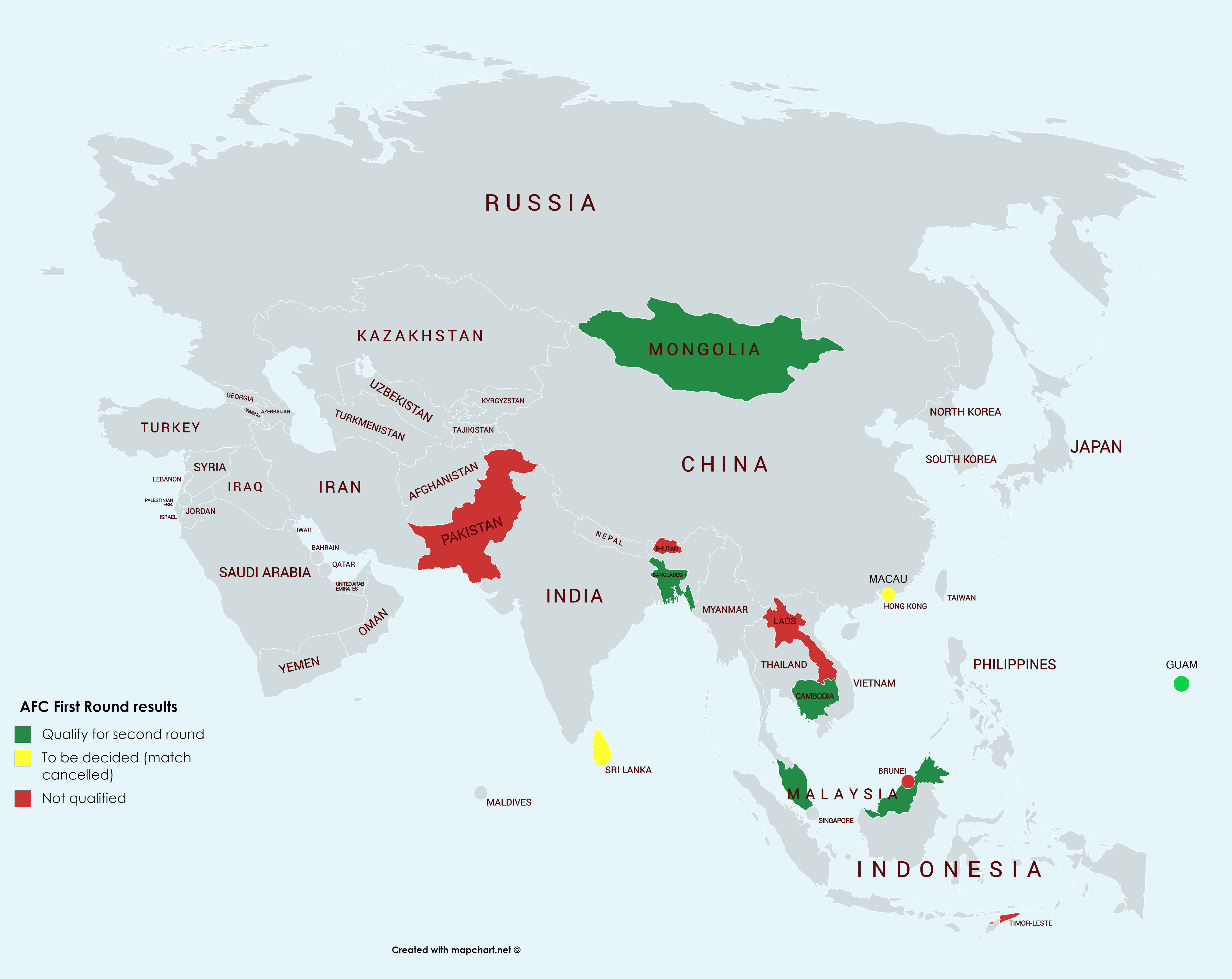
Anyway, going back to Asia, I realize that I haven’t made any mentions of the draw of the group stages for the second round. So I’ll discuss the groups before looking at today’s matches preserved for a later post in the coming days. Firstly, also following up on the latest post, in which it was unclear how the saga surrounding the cancellation of the Sri Lanka-Macau would play out, when during round 1 of the qualifiers in June, the Macau FA had refused to send their players to Sri Lanka due to security issues regarding terrorist attacks a couple of months prior to when the match was scheduled to be played. Despite their efforts trying to find a solution for the match, the Macau FA received a statement by FIFA on the 27th of June:

The match between Sri Lanka and Macau, which was due to be played on 11 June 2019, has been declared a 3-0 forfeit victory for Sri Lanka, with the Macau Football Association also receiving a fine of CHF 10,000 after the FIFA Disciplinary Committee considered the association liable for the breach of article 5 of the FIFA World Cup 2022 regulations (related to withdrawal, unplayed matches and abandoned matches) and article 56 of the FIFA Disciplinary Code (related to unplayed matches and abandonment).

https://www.fifa.com/worldcup/news/fifa-disciplinary-committee-sanctions-macau-football-association

This ensured Sri Lanka a place in the second round, while Macau has been eliminated from World Cup qualification, despite their 1-0 win from the first leg. The draw was then performed on the 17th of July, in which the remaining 40 AFC members were divided across eight groups in five, in which each team will play each other twice, ending June 2020. More info about the qualifying format can be acquired from an earlier post. The groups are (also shown on the map below:)

Source: FIFA.com
AFC Qualifiers Round 2 draw

As always, a draw creates some excitement around certain fixtures before any of the matches have actually been played, especially when groups include rivalries of some sort or when teams are considered to be somewhat equal and can therefore ‘fight’ for certain placings within the group, for example to ensure qualification for the next round. This particular situation makes the meetings between the two teams ‘key matches’ and ones sure to keep an eye on. This has however become somewhat extinct in modern football as a result of draws being based on seedings (derived from the FIFA World Cup ranking), ensuring that all the groups are of relatively equal strength as the groups contain teams from all levels of quality. However, there can always be an upset that catches the eyes. At the end, who doesn’t like a good underdog story, possibly of countries like Guam, the small island nation which hosts less than 200,000 people, or Sri Lanka, a much more populous island, however ranked lowest on the FIFA World Ranking (201st).

Looking at the groups, there are indeed some interesting fixtures to look forward to. What about North Korea vs South Korea in Group H? Two countries who share cultural heritage, decades of warfare, exclusion and the enormous political, social, economic, and even discrepancies in sports between the two. This is also interesting in the light of sportive collaborations between the two countries, established around the Winter Olympics last year in South Korea, in an effort to improve the mutual relationship. Interestingly, in football both countries have met each other quite regularly in the past decades, that is seven encounters in total since 2008. Oddly, between these matches, only six goals were scored (averaging less than one per match), as it ended 0-0 (3x) 1-1 (2x) and 1-0 (2x) in favour of South Korea. In fact, North Korea has only beaten the South in 17 confrontations (2-1 in 1990). However they’ve drawn eight times, of which six of their last nine meetings ended in a draw. Another interesting point is whether the homematch of North Korea will actually be played in Pyongyang, as during the 2010 FIFA World Cup qualifiers, in which they faced each other four times, the games were relocated to Shanghai, China, because the North Koreans refused to allow South Korea’s national anthem to play and flags to show. After three draws during this campaign, South Korea beat the North in the fourth game (1-0), although North Korea later accused the South of food poisoning. You can imagine then how these meetings are something to look forward to in curiosity, As it stands now, the North Korea home game is scheduled for next month and is to be played in the Kim Il-Sung Stadium (50,000 capacity) in Pyeongyang (unfortunately not in the colossal 114,000 seater national stadium), so mark your dates: North Korea – South Korea (15 October 2019) and South Korea – North Korea (4 June 2020).

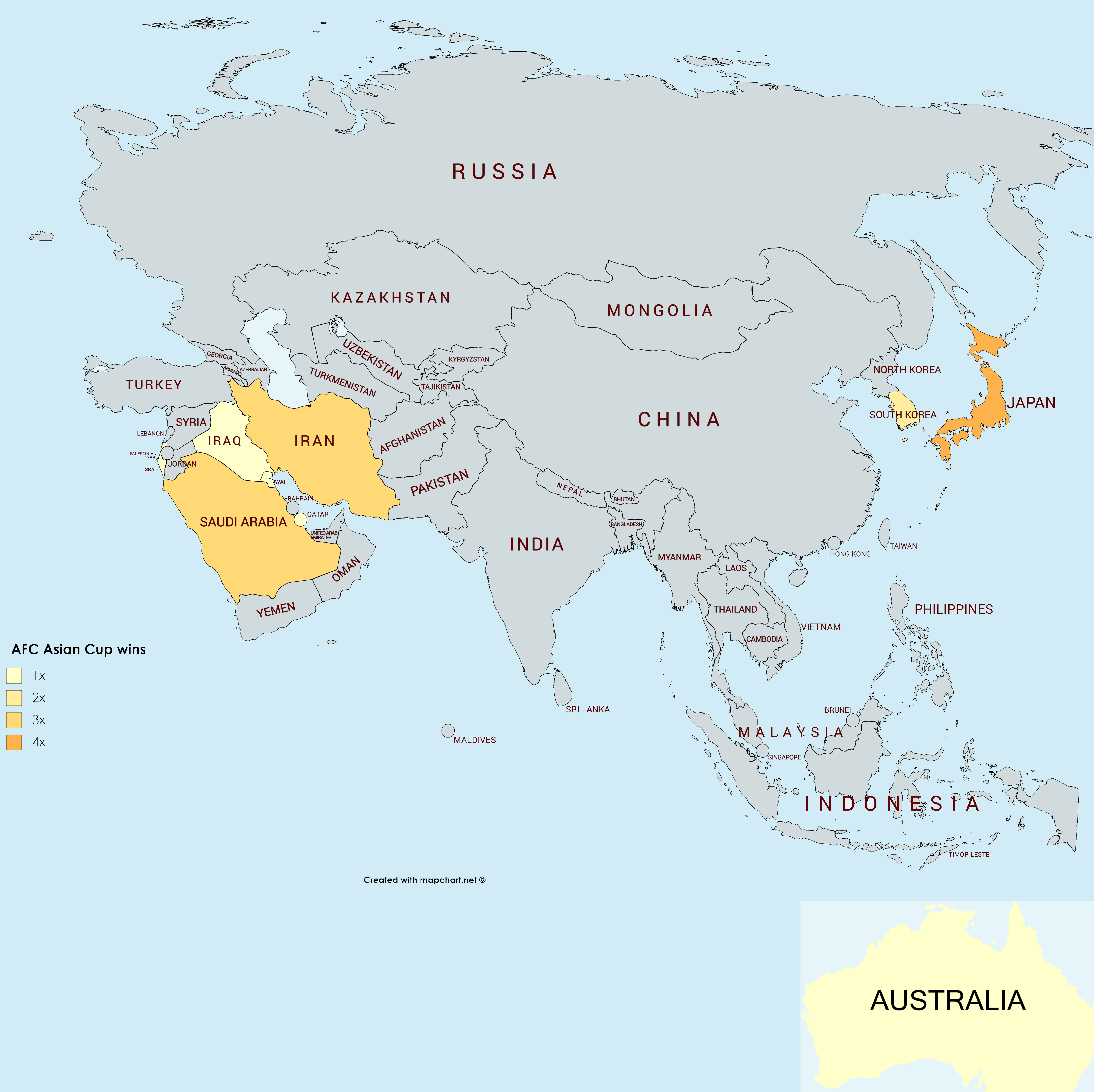
That was a long section… so, let’s move to the next one: Iran vs Iraq. Also two countries with a tumultuous past, including wars, which reached it heights during the 1980s. However they’re also two strong forces within Asian football. Whereas Iran is considered a true powerhouse in Asia with 3 Asian Cup wins (although the last one being from 1976) and 5 FIFA World Cup qualifications (4 of the last 6 World Cups), Iraq is also a force to be reckoned with, as it won the Asian Cup in 2007 and is the highest ranked nation from pot 2 during the draw for this group stage. Although Iran is historically the better between the two (winning 15 out of 28 confrontations), they have not been able to beat Iraq on the past two occasions (1 loss, 1 draw). They met each other as recently as January this year in a competitive game during the Asian Cup, which resulted in a 0-0 draw. They last played each other for FIFA World Cup qualification in 2001, when Iran got the better of Iraq twice (2x 2-1). Iran eventually just lost out on playing the 2002 FIFA World Cup, which was hosted in Asia by Japan and South Korea, by losing the Intercontinental play-off against Ireland (1-2 on aggregate). Although Iran should find little problems to qualify themselves for the third round, in probably one of the strongest groups, since all of the teams are ranked highly within their respective seedings, the games against Iraq are certainly something to look out for: Iraq – Iran (14 November 2019) and Iran – Iraq (9 June 2020).

So the final meeting(s) I want to dive into, basically includes most of Group G, which consists of four ASEAN or South-East Asian countries, i.e. Thailand, Vietnam, Malaysia and Indonesia. Moreover, Malaysia both shares borders with Thailand and Indonesia. It is then obvious that these games are quite interesting as these countries have a significant history with each other. For example, it is known that a Malaysian separatist movement exists within the southern part of Thailand, which hampered relations between the two countries for some time, although they’ve improved over time. On the other side, Indonesia, a huge and geographically scattered country (which actually played in the World Cup once, in 1938, as the Dutch East Indies, when it was still controlled by The Netherlands). Although these countries generally don’t share borders due to the infamous water strait of Malacca, the island of Borneo is actually divided between Malaysia, which control the north, and Indonesia, which control the southern part of the island. Futhermore, Malaysia (nicknamed the Malayan Tigers) made a good a impression in their first round match-up against Timor-Leste beating them 11-2 on aggregate. Although defensively they were a shambles, they do have quite some offensive power. Also, as a result of this result, they actually climbed up to the 159th place on the FIFA World Cup, just a single place ahead of Indonesia. So especially this one should be a competitive one. Furthermore, during the AFF (ASEAN Football Federation) Championship, held in Vietnam last December, Malaysia beat the higher ranked Thailand on away-goals over two legs in the semi-finals, only to lose on a single goal to Vietnam (also over two legs), which at the time was ranked about 100 places higher on FIFA World Ranking. Something to add, the first leg of this final was witnessed by over 88,000(!) people in Kuala Lumpur, so the atmosphere for any home game should be good. Also Indonesia has done well during this tournament, by reaching the finals twice (in 2010 to Malaysia and in 2016 to Thailand; which both happen to be in this group). What I’m trying to say is that it’s going to be a very interesting fight for second (and possibly even first place), which give access to the third round and I would place my bets on Malaysia on this one, although Thailand and Vietnam should have the advantage based on the rankings. During the first matchday on the 6th of September (actually today as I’m writing) Indonesia and Malaysia will kick the action in this group off. The other team in the group by the way is the United Arab Emirates (UAE), who did well during the Asian Cup as hosts earlier this year by reaching the semi-final and should be able to win the group.

Other interesting games that deserve at least a mention, but I won’t dwell too much on, as I have probably done too much for the previous ones:

  • Group A: China – Syria: Syria came close to qualifying for the 2018 FIFA World Cup, losing to Australia in the AFC playoffs. They might be able to challenge China for that number 1 spot.
  • Group A: China – Guam: A world power inhabited by 1,4 billion people against a territorial entity of the United States with a population of less than 200,000 and Guam has a much higher population density than China… In fact, the island of Guam would fit almost 18,000 times into China based on surface area. Ehmm… might end badly for the islanders, but the best imaginable story for a great upset! Guam did beat India during the 2018 FIFA World Cup qualifiers…!
  • Group B: Any game in Nepal. Every game to be played at 1,400 meters elevation, might catch some people out… Australia maybe (?). Interestingly, they haven’t played a competitive home game since November 2017 (0-0 vs. Philippines). I guess no one wants to play there voluntarily…
  • Group C: Iran – Iraq as mentioned earlier.
  • Group D: Saudi Arabia – Uzbekistan: Possibly doesn’t sound very exciting, but Uzbekistan has become close in the past few qualifying campaigns to reach top spots of their groups and qualify for the FIFA World Cup. For the 2014 campaign they actually finished on top of their group with Saudi Arabia, albeit equal on points, winning 3-0 at home, but losing 4-0 away. On the FIFA World Ranking the difference in only 15 places. Palestine might be a dangerous outsider however, beating Syria and Yemen (the latter also taking part in this group) and being the highest seeded nation in pot 3 during the draw. Saudi Arabia also shares borders with Yemen and Palestine, might also up the tension a bit, especially when they are heavily entangled in a civil war…
  • Group E: India – Bangladesh: this might be nicknamed the 1,5 billion people derby due to the enormous population of this area. Moreover, a bloody history, political tensions and a highly contested border are some fine ingredients for a good derby. Although this one might be much more interesting in cricket than in football to be honest, but you never know, they might get their bats out…
  • Group E: Qatar: Qatar is obviously a team to look out for, as they will be hosting and are therefore already qualified for the 2022 FIFA World Cup. This means that their games are basically friendlies (at least for Qatar), but the small nation on the peninsula of the Persian Gulf have impressed in recent times, especially by winning the Asian Cup earlier this year and left a decent impression on the Copa América as well. They’ll be looking to improve their team even more for when the real deal comes around. Oman will most likely prove to be the toughest opponent, as winners of the most recent Arab Gulf Cup in 2017.
  • Group F: Kyrgyzstan – Tajikistan (why are they AFC members, while Kazachstan is UEFA member), both former Soviet states, both tough to spell, especially when using different languages. They share borders (although it’s a shambles), are relatively close to each other on the FIFA World Ranking. Might be battling for second place behind Japan, so might be interesting or absolutely not… All I see, are opportunities for Guam to come second in this group…
  • Group G: Well, I’ve talked about this group at length, but for me this one excites me the most.
  • Group H: South Korea – North Korea of course. Although Lebanon and possibly Turkmenistan (ranked highest among pot 4 seedings) might be able to battle North Korea for that second spot. Also home to the worst ranked nation (201st) of the second round of the AFC qualifiers, who qualified as a result of the forfeit of their opponent in the first round, who had the upper hand after leg 1. Good luck!

So, at last, my prediction (for what it’s worth with limited knowledge about Asian football, but I’ve learnt a thing or two since starting this blog and it’s always a bit of fun 😉 Please note that this prediction is made after the first matchday had been completed. Although I didn’t analyse the results completely, there might be some bias based on those results (kuch… kuch… Tajikistan). Also keep in mind that the top spot and the four best-ranked second placings give access to the third round, in which the remaining 12 teams will be divided once again into groups (in groups of six). However, the other slots also contribute towards the 2023 AFC Asian Cup qualification. This means that every place has some kind of value, even third or fourth.

  • Group A: China, Syria, Philippines, Maldives, Guam
  • Group B: Australia, Jordan, Kuwait, Taiwan, Nepal
  • Group C: Iran, Iraq, Bahrain, Cambodia, Hong Kong
  • Group D: Saudi Arabia, Palestine, Uzbekistan, Yemen, Singapore (very tough especially between Palestine and Uzbekistan)
  • Group E: Qatar, Oman, India, Bangladesh, Afghanistan
  • Group F: Japan, Tajikistan, Kyrgyzstan, Myanmar, Mongolia
  • Group G: Vietnam, UAE, Malaysia, Thailand, Indonesia (very spicy, just like Thai food)
  • Group H: South Korea, Lebanon, Turkmenistan, North Korea, Sri Lanka

I’ll be updating the blog very soon about the first two matchdays of the AFC qualifiers second round and the first round of the CAF qualifiers!

AFC Qualifiers second round – What to look out for?

Today, we’ll discuss the teams that will compete in the second round of the AFC qualifiers for the FIFA World Cup 2022, which also happens to take place on the Asian continent, namely in Qatar. Since the first round has now (almost) come to a conclusion, we’ll look at how the 40 different teams that will be part of the draw to be held on the 17th of July, have done in their previous history, as well look at how the draw might play out. Note that not all AFC members join the FIFA World Cup qualifying campaign. Although the Northern Mariana Islands are a member of the Asian Football Confederation, but not of FIFA, making them inelegible to compete.

First some basic statements on the proceedings of the second round. A total of 40 Asian teams (including Australia and a few other island nations that are affiliated to the AFC) will be divided among groups of five. Qatar will also be drawn into a group, although they’re automatically qualified as host. The draw will be based on five different pots, in which teams are put on the basis of the official FIFA World Ranking as of the 14th of June. Pot 1 will include the highest ranked members, whereas pot 5 will that have qualified for the second round by defeating a team in the first round or through their FIFA World Ranking beforehand, with the aim of creating groups of similar strenghts, as well as giving an advantage to the ‘better’ teams by avoiding congestion.

The second round will commence on the 5th of September, from where each team will play each group member twice – home and away – meaning that each team will play eight matches in total during this round, with the final match to be played on the 9th of June 2020. The winners of each of the eight groups, as well as the four best runners-up, will qualify for the third round – meaning a total of 12 teams – in which new groups of six teams each will be created. Important sidenote to the second round is that every individual ranking in the groups also influences AFC Asian Cup qualification, with the tournament to be held in 2023.

Qatar will be third host country from Asia for the FIFA World Cup in history (behind Japan and South Korea who jointly organized the world cup in 2002). Although Qatar is automatically qualified for the tournament as a host, they will be competing from the second round onwards. Four AFC teams will directly qualify from the qualifiers to the FIFA World Cup. However another team could be joining the world cup through an extra AFC playoff match (the fourth round) and consequently an intercontinental playoff match.

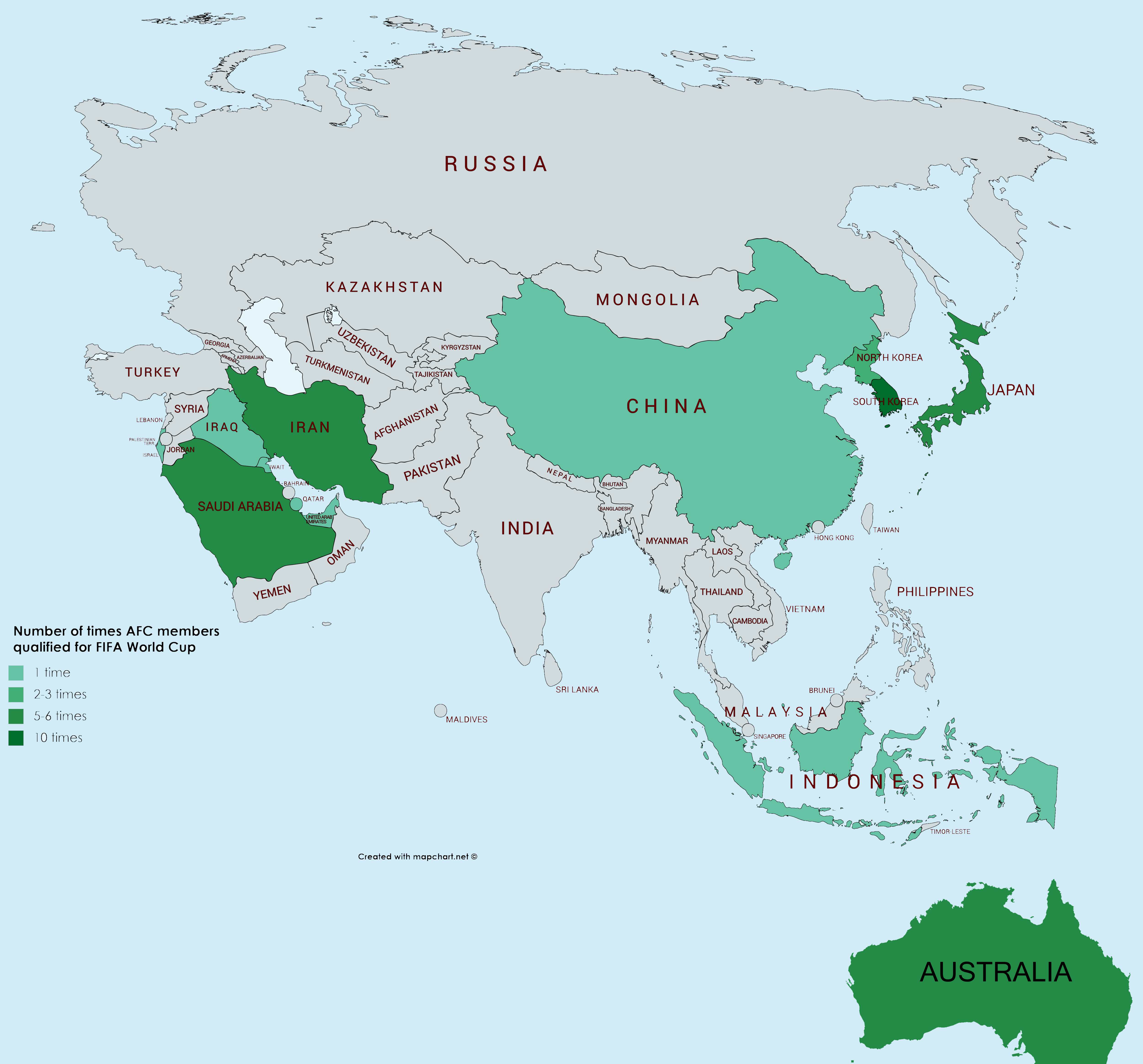
The first FIFA World Cup qualifying match regarding an Asian nation was to be played in the build-up of the 1934 FIFA World Cup, however the representing country – Turkey – withdrew before qualifying began. However, Palestine did compete as a British mandate during that campaign, as they faced Egypt for the first time on the 16th of March 1934 losing 7-1 to the Pharaohs. Three months later, the return match was played in current-day Israel, ending in 1-4 in front of 8,000 people, meaning that Egypt easily qualified for their first world cup after an 11-2 win on aggregate. Nevertheless, in the face of World War II, the Dutch East Indies – nowadays Indonesia – had to face Japan for a single knockout round for the world cup. Japan however withdrew, meaning that the Dutch East Indies was the first team from the Asian continent to qualify for the world cup of 1938 playe in France. The team lost 6-0 to Hungary in the first round and were immediately knocked out. In total 13 different AFC members would qualify for a FIFA World Cup at least once (including Qatar for the 2022 edition; Israel in 1970 before they transferred to UEFA in 1974; and Australia from 2010 onwards, since they joined the AFC in 2006), with South Korea reaching the best result under Guus Hiddink, as they became fourth during the 2002 FIFA World Cup as one of the host countries at the time, losing the semi-final to Germany and subsequentally the third place play-off against Turkey.

The teams

Pot 1

Iran

IRN
  • FIFA World Cup Ranking*: #20
  • Qualified for FIFA World Cup: 5x (1978, 1998, 2006, 2014, 2018)
  • Best FIFA World Cup performance: 14th; Round 1 (1978)
  • AFC Asian Cup Wins: 3 (1968, 1972, 1976)
  • Nickname: Team Melli
  • Head coach: Marc Wilmots (Belgium)
  • Current player with most caps: Ehsan Hajsafi (107)
  • Current player with most goals: Sardar Azmoun (28)

*as of 14 June 2019

Japan

JPN
  • FIFA World Cup Ranking: #28
  • Qualified for FIFA World Cup: 6x (1998, 2002 as host, 2006, 2010, 2014, 2018)
  • Best FIFA World Cup performance: 9th; round of 16 (2002, 2010)
  • AFC Asian Cup Wins: 4 (1992, 2000, 2004, 2011)
  • Nickname: Samurai Blue
  • Head coach: Hajime Moriyasu
  • Current player with most caps: Yuto Nagatomo (117)
  • Current player with most goals: Shinji Okazaki (50)

South Korea

KOR
  • FIFA World Cup Ranking: #37
  • Qualified for FIFA World Cup: 10x (1954, 1986, 1990, 1994, 1998, 2002 as host, 2006, 2010, 2014, 2018)
  • Best FIFA World Cup performance: 4th (2002)
  • AFC Asian Cup Wins: 2 (1956, 1960)
  • Nickname: Taegeuk Warriors / Tigers of Asia
  • Head coach: Paulo Bento (Portugal)
  • Current player with most caps: Ki Sung-yueng (110)
  • Current player with most goals: Son Heung-min (24)

Australia

AUS
  • FIFA World Cup Ranking: #43
  • Qualified for FIFA World Cup: 5x: 2x as OFC member (1974, 2006); 3x as AFC member (2010, 2014, 2018)
  • Best FIFA World Cup performance: 14th; Group stages (1974)
  • AFC Asian Cup Wins: 1 (2015)
  • Nickname: Socceroos
  • Head coach: Graham Arnold
  • Current player with most caps: Mark Milligan (79)
  • Current player with most goals: Tom Rogic / Mathew Leckie (9)

Qatar

QAT
  • FIFA World Cup Ranking: #55
  • Qualified for FIFA World Cup: 1x (2022 as host)
  • Best FIFA World Cup performance: –
  • AFC Asian Cup Wins: 1 (2019)
  • Nickname: Al-Annabi (The Maroons)
  • Head coach: Félix Sánchez Bas (Spain)
  • Current player with most caps: Hassan Al-Haydos (120)
  • Current player with most goals: Hassan Al-Haydos (26)

United Arab Emirates

UAE
  • FIFA World Cup Ranking: #67
  • Qualified for FIFA World Cup: 1x (1990)
  • Best FIFA World Cup performance: 24th; Group stages (1990)
  • AFC Asian Cup Wins: 0
  • Nickname: Al Abyad (The Whites) / Eyal Zayed (Sons of Zayed)
  • Head coach: Bert van Marwijk (Netherlands)
  • Current player with most caps: Ismail Al Hammadi (107)
  • Current player with most goals: Ahmed Khalil (51)

Saudi Arabia

KSA
  • FIFA World Cup Ranking: #69
  • Qualified for FIFA World Cup: 5x (1994, 1998, 2002, 2006, 2018)
  • Best FIFA World Cup performance: 12th; Round of 16 (1994)
  • AFC Asian Cup Wins: 3 (1984, 1988, 1996)
  • Nickname: al-‘Akhdar (The Green One) / as-Sugur al-‘Akhdar (The Green Falcons) / Falcons of Najd and Hejaz
  • Head coach: Murshid Khamis
  • Current player with most caps: Hussein Abdulghani / Osama Hawsawi (138)
  • Current player with most goals: Mohammad El-Sahlawi (28)

China

CHN
  • FIFA World Cup Ranking: #73
  • Qualified for FIFA World Cup: 1x (2002)
  • Best FIFA World Cup performance: 31st; Group stages (2002)
  • AFC Asian Cup Wins: 0
  • Nickname: Lóng zhi dui (Team Dragon)
  • Head coach: Marcello Lippi (Italy)
  • Current player with most caps: Gao Lin (109)
  • Current player with most goals: Yang Xu (23)

Pot 2

Iraq

IRQ
  • FIFA World Cup Ranking: #77
  • Qualified for FIFA World Cup: 1x (1986)
  • Best FIFA World Cup performance: 23rd; Group stages (1986)
  • AFC Asian Cup Wins: 1 (2007)
  • Nickname: Asood Al-Rafidain (Lions of Mesopotamia)
  • Head coach: Srecko Katanec (Slovenia)
  • Current player with most caps: Ahmad Ibrahim (85)
  • Current player with most goals: Mohannad Abdul-Raheem (10)

Uzbekistan

UZB
  • FIFA World Cup Ranking: #82
  • Qualified for FIFA World Cup: 0x
  • Best FIFA World Cup performance: –
  • AFC Asian Cup Wins: 0
  • Nickname: White Wolves / Turanians / Asian Italy / Huma Birds
  • Head coach: Héctor Cúper (Argentina)
  • Current player with most caps: Ignatiy Nesterov (106)
  • Current player with most goals: Odil Ahmedov (19)

Syria

SYR
  • FIFA World Cup Ranking: #85
  • Qualified for FIFA World Cup: 0x
  • Best FIFA World Cup performance: –
  • AFC Asian Cup Wins: 0
  • Nickname: Qasioun Nosour (The Assyrians)
  • Head coach: Fajr Ibrahim
  • Current player with most caps: Firas Al-Khatib (66)
  • Current player with most goals: Firas Al-Khatib (31)

Oman

OMA
  • FIFA World Cup Ranking: #86
  • Qualified for FIFA World Cup: 0x
  • Best FIFA World Cup performance: –
  • AFC Asian Cup Wins: 0
  • Nickname: Al-Ahmar (The Reds) / Samba Al-Khaleej (Gulf Samba)
  • Head coach: Erwin Koeman (Netherlands)
  • Current player with most caps: Ahmed Mubarrak Al-Mahaijri (169)
  • Current player with most goals: Ahmed Mubarrak Al-Mahaijri (21)

Lebanon

LBN
  • FIFA World Cup Ranking: #86
  • Qualified for FIFA World Cup: 0x
  • Best FIFA World Cup performance: –
  • AFC Asian Cup Wins: 0
  • Nickname: The Cedars
  • Head coach: Liviu Ciobotariu (Romania)
  • Current player with most caps: Hassan Maatouk (75)
  • Current player with most goals: Hassan Maatouk (20)

Kyrgyztan

KGZ
  • FIFA World Cup Ranking: #95
  • Qualified for FIFA World Cup: 0x
  • Best FIFA World Cup performance: –
  • AFC Asian Cup Wins: 0
  • Nickname: The White Falcons
  • Head coach: Aleksandr Krestinin (Russia)
  • Current player with most caps: Mirlan Murzaev (40)
  • Current player with most goals: Anton Zemlianukhin (13)

Vietnam

VIE
  • FIFA World Cup Ranking: #96
  • Qualified for FIFA World Cup: 0x
  • Best FIFA World Cup performance: –
  • AFC Asian Cup Wins: 0
  • Nickname: Rong Vang (Golden Dragons)
  • Head coach: Park Hang-seo (South Korea)
  • Current player with most caps: Nguyen Trong Hoang (64)
  • Current player with most goals: Nguyen Van Quyet (13)

Jordan

JOR
  • FIFA World Cup Ranking: #98
  • Qualified for FIFA World Cup: 0x
  • Best FIFA World Cup performance: –
  • AFC Asian Cup Wins: 0
  • Nickname: The Chivalrous
  • Head coach: Vital Borkelmans (Belgium)
  • Current player with most caps: Amer Shafi (144)
  • Current player with most goals: Hamza Al-Dardour (27)

Pot 3

Palestine

PLE
  • FIFA World Cup Ranking: #100
  • Qualified for FIFA World Cup: 0x
  • Best FIFA World Cup performance: –
  • AFC Asian Cup Wins: 0
  • Nickname: Lions of Canaan / The Fedayeen / The Knights
  • Head coach: Noureddine Ould Ali (Algeria)
  • Current player with most caps: Khader Yousef (64)
  • Current player with most goals: Ashraf Nu’man (12)

India

IND
  • FIFA World Cup Ranking: #101
  • Qualified for FIFA World Cup: 1x (1950, but withdrew before the tournament)
  • Best FIFA World Cup performance: –
  • AFC Asian Cup Wins: 0
  • Nickname: Blue Tigers
  • Head coach: Igor Stimac (Croatia)
  • Current player with most caps: Sunil Chhetri (108)
  • Current player with most goals: Sunil Chhetri (64)

Bahrain

BHR
  • FIFA World Cup Ranking: #110
  • Qualified for FIFA World Cup: 0x
  • Best FIFA World Cup performance: –
  • AFC Asian Cup Wins: 0
  • Nickname: Muharabi Dilmun (Dilmun’s Warriors)
  • Head coach: Hélio Sousa (Portugal)
  • Current player with most caps: Abdulwahab Al-Safi (84)
  • Current player with most goals: Mohamed Al Romaihi / Jamal Rashid (8)

Thailand

THA
  • FIFA World Cup Ranking: #116
  • Qualified for FIFA World Cup: 0x
  • Best FIFA World Cup performance: –
  • AFC Asian Cup Wins: 0
  • Nickname: Changsuek (War Elephants)
  • Head coach: Vacant
  • Current player with most caps: Teerasil Dangda (100)
  • Current player with most goals: Teerasil Dangda (43)

Tajikistan

TJK
  • FIFA World Cup Ranking: #120
  • Qualified for FIFA World Cup: 0x
  • Best FIFA World Cup performance: –
  • AFC Asian Cup Wins: 0
  • Nickname: The Crowns / The Persian Lions / Sons of the Highlands / Pamirians
  • Head coach: Usman Toshev (Uzbekistan)
  • Current player with most caps: Akhtam Nazarov (40)
  • Current player with most goals: Parvizdzhon Umarbayev (6)

North Korea

PRK
  • FIFA World Cup Ranking: #122
  • Qualified for FIFA World Cup: 2x (1966, 2010)
  • Best FIFA World Cup performance: 8th; Quarter finals (1966)
  • AFC Asian Cup Wins: 0
  • Nickname: Chollima
  • Head coach: Yun Jong-su
  • Current player with most caps: Ri Myung-guk (120)
  • Current player with most goals: Jong Il-gwan (21)

Chinese Taipei (Taiwan / Republic of China)

TPE
  • FIFA World Cup Ranking: #125
  • Qualified for FIFA World Cup: 0x
  • Best FIFA World Cup performance: –
  • AFC Asian Cup Wins: 0
  • Nickname: –
  • Head coach: Louis Lancaster (England)
  • Current player with most caps: Chen Po-Liang (73)
  • Current player with most goals: Chen Po-Liang (25)

Philippines

PHI
  • FIFA World Cup Ranking: #126
  • Qualified for FIFA World Cup: 0x
  • Best FIFA World Cup performance: –
  • AFC Asian Cup Wins: 0
  • Nickname: Azkals (Street Dogs)
  • Head coach: Scott Cooper (England)
  • Current player with most caps: Phil Younghusband (108)
  • Current player with most goals: Phil Younghusband (52)

Pot 4

Turkmenistan

TKM
  • FIFA World Cup Ranking: #135
  • Qualified for FIFA World Cup: 0x
  • Best FIFA World Cup performance: –
  • AFC Asian Cup Wins: 0
  • Nickname: Emeralds / Akhal-Teke’s / Greens / Karakum Warriors
  • Head coach: Ante Misa (Croatia)
  • Current player with most caps: Arslanmyrat Amanow (35)
  • Current player with most goals: Arslanmyrat Amanow (8)

Myanmar

MYA
  • FIFA World Cup Ranking: #138
  • Qualified for FIFA World Cup: 0x
  • Best FIFA World Cup performance: –
  • AFC Asian Cup Wins: 0
  • Nickname: The Asian Lions
  • Head coach: Miodrag Radulovic (Montenegro)
  • Current player with most caps: Zaw Min Tun (65)
  • Current player with most goals: Kyaw Ko Ko (16)

Hong Kong

HKG
  • FIFA World Cup Ranking: #141
  • Qualified for FIFA World Cup: 0x
  • Best FIFA World Cup performance: –
  • AFC Asian Cup Wins: 0
  • Nickname: The Strength
  • Head coach: Mixu Paatelainen (Finland)
  • Current player with most caps: Yapp Hung Fai (67)
  • Current player with most goals: Chan Siu Ki (37)

Yemen

YEM
  • FIFA World Cup Ranking: #144
  • Qualified for FIFA World Cup: 0x
  • Best FIFA World Cup performance: –
  • AFC Asian Cup Wins: 0
  • Nickname: Al-Yaman A’Sa’Eed (The Happy Yemen) / Al-Shayateen Al-Homr (The Red Devils) / Qahtani Arabs
  • Head coach: Ján Kocian (Slovakia)
  • Current player with most caps: Alaa Al-Sasi (63)
  • Current player with most goals: Alaa Al-Sasi (8)

Afghanistan

AFG
  • FIFA World Cup Ranking: #149
  • Qualified for FIFA World Cup: 0x
  • Best FIFA World Cup performance: –
  • AFC Asian Cup Wins: 0
  • Nickname: –
  • Head coach: Anoush Dastgir
  • Current player with most caps: Zohib Islam Amiri (52)
  • Current player with most goals: Faysal Shayesteh (9)

Maldives

MDV
  • FIFA World Cup Ranking: #151
  • Qualified for FIFA World Cup: 0x
  • Best FIFA World Cup performance: –
  • AFC Asian Cup Wins: 0
  • Nickname: The Sea / Red Snapper
  • Head coach: Petar Segrt (Germany)
  • Current player with most caps: Ali Ashfaq (77)
  • Current player with most goals: Ali Ashfaq (52)

Kuwait

KUW
  • FIFA World Cup Ranking: #156
  • Qualified for FIFA World Cup: 1x
  • Best FIFA World Cup performance: 21st; Group stages (1982)
  • AFC Asian Cup Wins: 1 (1980)
  • Nickname: Al-Azraq (The Blue) / The Blue Wave
  • Head coach: Romeo Jozak (Croatia)
  • Current player with most caps: Bader Al Mutawa (167)
  • Current player with most goals: Bader Al Mutawa (55)

Malaysia

MAS
  • FIFA World Cup Ranking: #159
  • Qualified for FIFA World Cup: 0x
  • Best FIFA World Cup performance: –
  • AFC Asian Cup Wins: 0
  • Nickname: Harimau Malaya (Malayan Tigers) / Skuad Kebangsaan (National Team)
  • Head coach: Tan Cheng Hoe
  • Current player with most caps: Aidil Zafuan Radzak (82)
  • Current player with most goals: Norshahrul Idlan Talaha (13)

Pot 5

Indonesia

IDN
  • FIFA World Cup Ranking: #160
  • Qualified for FIFA World Cup: 1x (1938 as Dutch East Indies)
  • Best FIFA World Cup performance: 15th; Round 1 (1938)
  • AFC Asian Cup Wins: 0
  • Nickname: Merah Putih (The Red and White) / Tim Garuda (Garuda’s Team)
  • Head coach: Simon McMenemy (Scotland)
  • Current player with most caps: Boaz Solossa (48)
  • Current player with most goals: Boaz Solossa (14)

Singapore

SIN
  • FIFA World Cup Ranking: #162
  • Qualified for FIFA World Cup: 0x
  • Best FIFA World Cup performance: –
  • AFC Asian Cup Wins: 0
  • Nickname: The Lions
  • Head coach: Tatsuma Yoshida (Japan)
  • Current player with most caps: Shahril Ishak (138)
  • Current player with most goals: Khairul Amri (32)

Nepal

NEP
  • FIFA World Cup Ranking: #165
  • Qualified for FIFA World Cup: 0x
  • Best FIFA World Cup performance: –
  • AFC Asian Cup Wins: 0
  • Nickname: The Gorkhalis
  • Head coach: Johan Kalin (Zweden)
  • Current player with most caps: Kiran Chemjong (58)
  • Current player with most goals: Bharat Khawas (10)

Cambodia

CAM
  • FIFA World Cup Ranking: #169
  • Qualified for FIFA World Cup: 0x
  • Best FIFA World Cup performance: –
  • AFC Asian Cup Wins: 0
  • Nickname: Angkor Warriors / Kouprey Kampuchea
  • Head coach: Félix Dalmás (Argentina)
  • Current player with most caps: Khoun Laboravy (56)
  • Current player with most goals: Chan Vathanaka (16)

Bangladesh

BAN
  • FIFA World Cup Ranking: #183
  • Qualified for FIFA World Cup: 0x
  • Best FIFA World Cup performance: –
  • AFC Asian Cup Wins: 0
  • Nickname: Bengal Tiger / Red and Green
  • Head coach: Jamie Day (England)
  • Current player with most caps: Mamunul Islam (57)
  • Current player with most goals: Shakhawat Hossain Rony (7)

Mongolia

MNG
  • FIFA World Cup Ranking: #187
  • Qualified for FIFA World Cup: 0x
  • Best FIFA World Cup performance: –
  • AFC Asian Cup Wins: 0
  • Nickname: Khökh Chononuud (Blue Wolves)
  • Head coach: Michael Weiß (Germany)
  • Current player with most caps: Bayasgalangiin Garidmagnai (34)
  • Current player with most goals: Naranbold Nyam-Osor (8)

Guam

GUM
  • FIFA World Cup Ranking: #190
  • Qualified for FIFA World Cup: 0x
  • Best FIFA World Cup performance: –
  • AFC Asian Cup Wins: 0
  • Nickname: Matao
  • Head coach: Karl Dodd (Australia)
  • Current player with most caps: Jason Cunliffe (41)
  • Current player with most goals: Jason Cunliffe (22)

Macau or Sri Lanka

The match between Sri Lanka and Macau which was to be played on the 11th of June was cancelled after the Macau FA refused to send their players to Sri Lanka due to security issues regarding terrorist attacks that took place on the 21st of April earlier this year, in which more than 200 people were killed. Nicholas Torrão, Macau’s captain, has sent a letter to the FIFA and AFC associates, since the qualifying matches also falls under AFC authority as these games also serve as qualifiers for the 2023 Asian Cup, requesting the game to be rescheduled. Macau had won the first leg 1-0 and were looking to qualify for the second round for their first time.

Game cancelled due to security issues; Guam qualifies for the second time in a row after major result

We note the 11th of June as the day of the second leg matches for the first round of the AFC Qualifiers, which determines the six teams that will join the other AFC members for the group stages in the second round.

One spot will remain open however for an unknown length of time after Macau withdrew from the match against Sri Lanka – after having a 1-0 advantage from the first leg which marked the first ever FIFA qualifier win by the Greens after gaining admission to FIFA for the 1994 qualifying campaign – as the Macau FA decided not to send their players to the Sri Lankan capital Colombo, stating on social media that “Due to the recent terrorist attack in Sri Lanka and for the sake of the team’s personal safety, we have been in contact with FIFA, AFC and Football Federation of Sri Lanka (FFSL) to discuss and negotiate that this match to be played in neutral country. MFA will have to put our players’ personal safety as a priority. And, in the view of the fact that we cannot guarantee the safety of the team while they are in Sri Lanka and we cannot afford to take the risk to put our players’ lives in danger.”

At current time, it’s unknown whether the match will be played in a different location or a neutral venue as the Macau FA had suggested or that one of the teams will be punished for their actions. But the issue should soon to be resolved as the draw for the second round will take place at the 17th of July.

Another match that revolved around issues was the return match between Pakistan and Cambodia, that played out in the Hamid bin Khalifa Stadium in Doha, Qatar due to internal issues in the Pakistan Football Federation. Although taking place in the host country of the World Cup, the specific stadium will not be a venue during the main event, as it only holds a capacity of 12,000, way below the standards of 40,000 that FIFA poses to World Cup hosts. Already having to overcome a 2-0 defeat, Pakistan thus played in a location where they were not accustomed to. However they took the lead in the 18th minute when – Copenhagen born – Hassan Bashir tucked away a penalty, given after a handball, in front of a crowd of a mere 300 at 36 degrees celsius. Cambodia – nicknamed the ‘Angkor Warriors’ – put up a better performance in the second half and retained the lead after goals by Rosib and Bunheing leading them to a 4-1 win on aggregate and their second qualification for the second round in history.

However the main story would come from the small island nation of Guam – an overseas territory of the Unites States – where their national team played against Bhutan, who came into the match defending a 1-0 lead. It soon became clear that Bhutan – the ‘Dragon Boys’ – without their home advantage, was no match for the unleashed Matao who put five away in front of 1,000 supporters. After 27 minutes into the match, Guam were already on their way to the second round after a 2-0 advantage and were never put in doubt by the Bhutanese as Guam all-time topscorer Jason Cunliffe managed to complete a hattrick in the final seconds of the game. Although Bhutan ranks a few places higher on the FIFA World Ranking than Guam, a 5-1 win on aggregate gives Guamanians are going to the second round for the second time in history, after an impressive run for the 2018 FIFA World Cup in Russia, in which they managed to beat India and Turkmenistan.

The most tension was probably to be found in Bandar Seri Begawan – the capital city of Brunei Darussalam – where Brunei was almost able to overcome the 2-0 deficit against Mongolia from last week. Both in the 4th and 34th minute, more than 17,000 Bruneians got on their feet to celebrate a goal, as on both occasions Razimie Ramlli was able to profit from poorly handled free-kicks by Mongolian goalkeeper Saikhanchuluun Amarbayasgaslan, which meant that both teams were equal on aggregate. Early second half however Mongolian captain Norjmoogiin Tsedenbal was managed to convert a penalty. The second goal by the defender – after also scoring in the home match – left the Bruneians to a difficult task to score two to qualify for the second round, which didn’t happen. This has meant that the ‘Blue Wolves’ have managed to get into the group stages of the second round for the first time ever since taking in FIFA qualifiers in 2001.

Elsewhere in Asia, Bangladesh was able to manage their 1-0 lead to Laos from the first leg, as the game ended in a goalless draw in front of their home crowd of around 7,500. The home side even created the greatest chances to win the game and extend their lead over two legs, but the 0-0 turned out to be enough for the Bengal Tiger to qualify for the second round. Toward the south-eastern edge of the Asian continent, Malaysia played out their qualifying match against Timor-Leste after already beating them at home in Kuala Lumpur by 7-1. Also on this day, the ‘Malayan Tigers’ had little problems with the former Portuguese colony, as they managed to win by a fine margin of four: 1-5. The score could have been higher as both sides failed to score a penalty, after Malaysia had already missed one during the first match. Through a hattrick Shahrel Fikri, he is now considered as the top goalscorer of the FIFA World Cup 2022 qualifying campaign, after he also scored a goal in the first leg.

Results of today (11 June 2019)

AFC Qualifiers - First Round: Second legs
Brunei 2-1 Mongolia (2-3 agg.)
Sri Lanka (cancelled) Macau (0-1 agg.)
Bangladesh 0-0 Laos (1-0 agg.)
Timor-Leste 1-5 Malaysia (2-12 agg.)
Pakistan 1-2 Cambodia (1-4 agg.)
Guam 5-0 Bhutan (5-1 agg.)

Malaysia to impress in AFC Qualifiers?

Only a few hours before the FIFA Women’s World Cup kicks off in France, Malaysia and Timor-Leste played the sixth official qualifying match for the men’s equivalent to be played in 2022. The hometeam – playing in the astonishing 87,000 Bukit Jalil National Stadium in the nation’s capital Kuala Lumpur. which was only filled for about 5 percent – came in as heavy favourites when facing the former Portuguese colony of Timor Leste (also known as East Timor), as the ‘Malayan Warriors’ were ranked highest on the FIFA World Ranking (ranked #168) of the twelve teams starting in the first round of the AFC qualifiers and finishing second in the AFF Championship – featuring eight teams from the South East Asia region – losing the final to Vietnam only six months ago.

The predictions seemed right as the home team easily dispatched the Timorese by 7-1. The Malaysians – playing in their traditional gold and black colours – started bright scoring two goals inside 23 minutes, although the score could have been higher as Safari Rasid missed a penalty in the 18th minute followed shortly after by a close header in front of open goal went wide. However, Rasid would make up for the missed penalty by scoring two very confidently taken shots turning into goals (4-0 and 5-1) later in the match. Timor-Leste – nicknamed ‘The Little Samba Nation’ – was not able to play much samba football, although they were sometimes dangerous with their counterattacks, which led to one goal by 18-year-old Jõao Pedro, who plays in the third level of the Thai football system. The 6-1 might be the biggest highlight of the match, as Faiz Nasir beautifully struck a one-time volley.

The single Timorese away goal will be unlikely enough to come back to, as Malaysia should easily claim their spot for the second qualifying round of the AFC, in which 40 Asian teams (and Australia) will be divided among eight groups of five. Today’s match produced more goals than the other five matches in the first round that were played yesterday, totalling 15 goals over six matches as of now. All the return matches of the round will be played next Tuesday, on the 11th of June.

Results of today (7 June 2019)

AFC Qualifiers - First round: first leg
Malaysia 7-1 Timor-Leste

We’re underway!

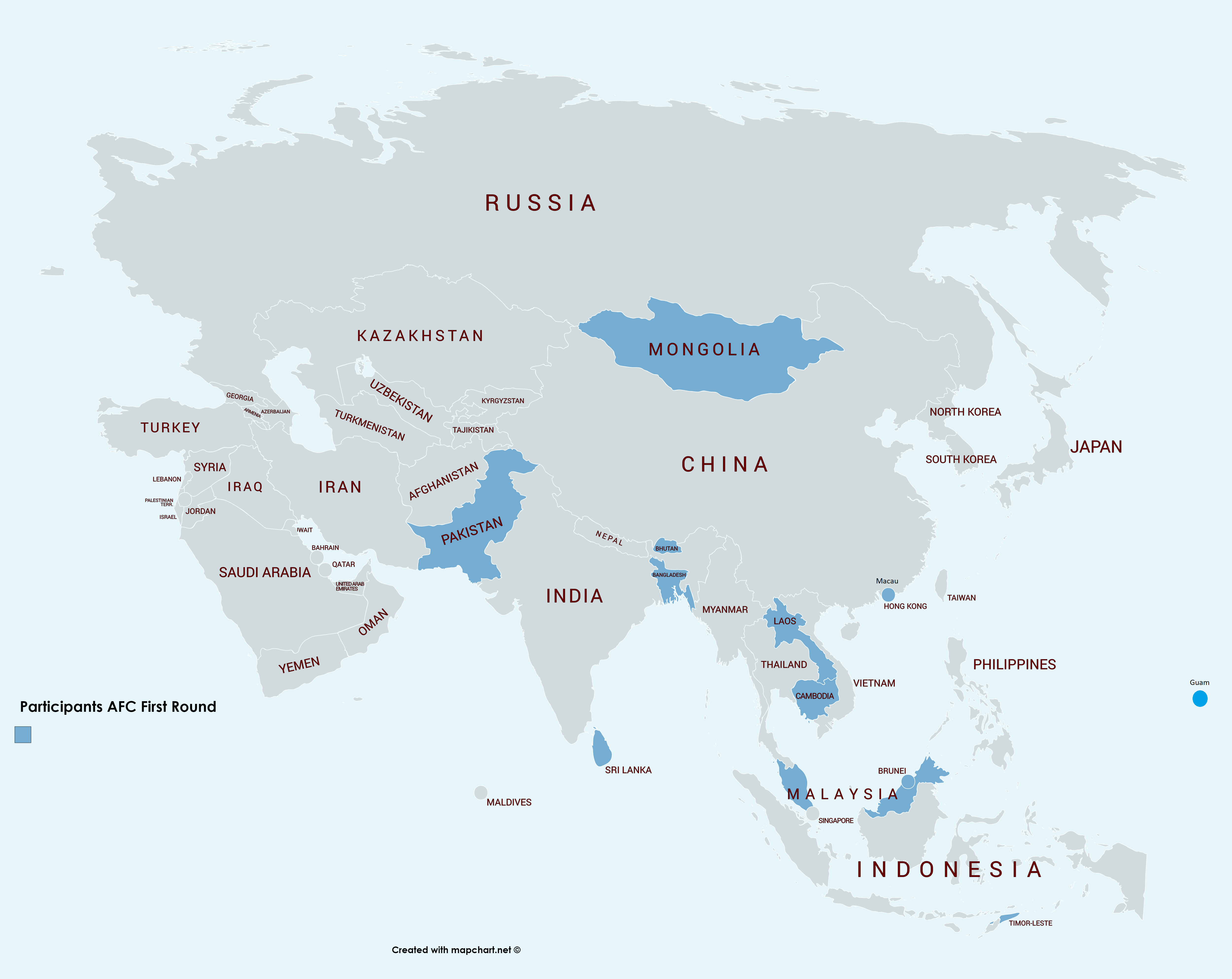
It is June the 6th, almost three and a half years away from the FIFA World Cup 2022 will be upon us and interestingly, one day before the official opening of the FIFA Women’s World Cup 2019 in France, the first balls have been rolling in the qualifiers for the holy grail of men’s football; the FIFA World Cup. The honours were for Mongolia, who faced the small nation of Brunei to officially kick off the AFC qualifiers for the FIFA World Cup to be played in 2022 in Qatar. In the first round of the AFC qualifiers, the 12 lowest ranked teams that are member of the AFC – which is the governing body of Asian football decide over two legs who gain a ticket for the group stages in the second round. Although the official FIFA World Ranking doesn’t give much away in terms of difference in quality between the two teams (Mongolia ranked 187th and Brunei ranked 194th), Mongolia – nicknamed the ‘Blue Wolves’ and coached by German Michael Weiß – grabbed their first win in front of around 1,700 spectators in the MFF Football Centre in Ulaanbaatar – the capital of contemporary Mongolia – as it ended 2-0. Both goals were scored by Mongolian players, playing in their native top division. The first goal FIFA World Cup qualifiers – the 1-0 for Mongolia – was a free kick struck by captain Norjmoogiin Tsedenbal, which went well out of reach from Bruneian goalkeeper Haimie Anak Nyaring from about 20 metres out. Later in the game, Nyam-Osor Naranbold, striker for Athletic 220, managed to bag his eigth international goal in his career, which levels him with former defender Donorovyn Lümbengarav and secured the victory for the Mongols. Both teams had beforehand only won one FIFA World Cup qualifying match ever, which was never enough to secure a place in the second round. Mongolia has now taken a big step in the right direction by doubling their winning record and taking the lead in the two-legged affair, and are on their way to overcome their historical record and thereby secure their place in the group stages of the second round. An away leg to the oil-rich country on the island of Borneo however still awaits.

What on forehand was most likely to be the most interesting of five matches today, was the game between Cambodia and Pakistan, played in Cambodia’s capital Phnom Penh. More than 33,000 people turned up to the olympic stadium to watch their ‘Angkor Warriors’ perform against the Pakistani. Cambodia – under the wings by Japan legend Keisuke Honda (general manager) – had a relatively easy task in putting away Pakistan and managed to secure a 2-0 win. Having said that, the goals didn’t come easy, as they were only scored in the 81st and 84th minute respectively. Pakistan continues their current run 31 FIFA World Cup qualifying matches without a win, even more horrific if taken into account that the massive Islamic country hosts a population size similar to that of the United States. One silver lining though is the debut of 20-year-old Rahis Naby, who shortly played in the youth academy of Premier League-side Burnley FC. However, it seems unlikely that Pakistan will overcome today’s result given their incredibly long winningless run.

Elsewhere, one of the revelations of the 2018 FIFA World Cup qualifying campaign – the United States-governed island state of Guam – lost their away-match to Bhutan in the 45,000 capacity Changlimithang Stadium for a crowd of around 8,000. Four years ago Guam stunned both Turkmenistan and India (that has a population of over one billion) by beating them in the second round group stages and finishing fourth in their group with seven points, whilst it was the first time since 2002 they participated in the qualifiers after a horrific start, leaking 35 goals and scoring zero in 2000 when they played both Iran (0-19) and Tajikistan (0-16). Today only a 0-1 loss does keep them in the race when they bring the ball back to Dededo, Guam next week.

Two other games were played, where Laos was beaten by Bangladesh in front of almost 5,000 spectators after a powerful low strike by Robiul Hasan in the 71st minute, giving the visitors the 1-0 away-goal lead towards their return match to be played in the Bangabandhu National Stadium in Dhaka. Macau won their home-leg against Sri Lanka by the same scoreline after an error by Sri Lankan goalie Weerasinghe Sujan who fumbled the ball, which was eventually tapped in by Portuguese-born Filipe Duarte.

One more game will be played tomorrow, when favourites of the first round of the AFC qualifiers Malaysia takes on Timor-Leste on their home ground in Kuala Lumpur. The returns will be played early next week on the 11th of June.

Results of today (6 June 2019):

AFC Qualifiers - First Round: first legs
Mongolia 2-0 Brunei
Macau 1-0 Sri Lanka
Laos 0-1 Bangladesh
Cambodia 2-0 Pakistan
Bhutan 1-0 Guam

FIFA World Cup 2022 Qatar

This blog is about the FIFA World Cup that is taking place in Qatar in 2022. In short, the aim is to follow anything that happens in the world of world cup football and share this with other enthousiasts. To get more information what the blog is all about, please visit the description page.

First some minor background about the world cup in Qatar:

  • On 2 December 2010, the host nations were announced for both the 2018 and 2022 edition of the world cup after a voting process performed by the FIFA executive committee, consisting of 22 elected members. Whereas the 2018 FIFA World Cup was to be held in Russia, the 2022 edition went to Qatar. Other contenders for that World Cup were the United States and fellow Asian country Japan, which had both previously hosted a world cup in the past (USA in 1994 and Japan in 2002, albeit joint with South Korea).
  • It is the first time a FIFA World Cup will be hosted in Qatar and also the first time in the Middle East region, and only the second time that the tournament will be held on the Asian continent (after South Korea and Japan in 2002).
  • The allocation of the World Cup to Qatar has been met with much controversy. First of all, there have been strong signs of corruption surrounding the Qatar and the members of FIFA at the time when Sepp Blatter was president of the organization. See Garcia Report for more information on that topic.
  • Secondly, there has been strong among football fans due to the lack of footballing history in the country. The Qatar national football team has never been able to qualify for a World Cup, but will, as being the host, be automatically qualified for the tournament. At the time Qatar was announced as host, it was ranked #112 on the FIFA World Ranking. Qatar has been able to grow the sport massively in the past decade, highlighted by becoming champion of the AFC Asian Cup early 2019 for the first time. This has contributed to significantly to Qatar’s current position on the world ranking as #55, in the region of African powerhouses such as Ghana, Cameroon and Egypt. Furthermore, it has been able to attract some world class players in the names of Xavi and Wesley Sneijder, whereas the influence of Qatari’s in world football is not to be underestimated, as for example top European clubs are owned by Qatari sheiks, most significantly in the form of Paris Saint-Germain FC and the role of Qatari enterprises (Qatar Airways) as main sponsors of major football clubs, such as FC Barcelona and AS Roma.
  • Thirdly, Qatar is a very small country, namely the 158th ranked country in the world (11,581 km2/4,471 sq mi). It will be in fact the smallest country in the history of the FIFA World Cup, dethroning Switzerland, which hosted the world cup in 1954. This would make it difficult to host a tournament due to the magnitude of a world cup, as 4 of the 8 stadiums purposively built for the world cup are based in the nation’s capital Doha. Also the climate in Qatar has not been considered optimal in many eyes, as the temperatures around June/July when the tournament is generally held, can reach up to 50 degrees celsius averaging around 35 degrees in the day. This has led to the decision by FIFA to reschedule the tournament towards wintertime. This was announced in 2018 and will mean that the tournament will be played in November and December of 2022.
  • Fourthly, there have been many concerns about the functioning of the Qatari government, especially concerning the treatment of human rights linked to racism and discrimation against homosexuals, as well as alleged slavery of migrant workers in the constructions surrounding the world cup venues as many Nepalese and Indian migrants have died during the works and have been discovered to be working in extremely unsafe conditions as well as to be living in inhumane circumstances. There have also been allegations that the state government of Qatar financially aids terrorist groups.
  • Lastly, there have been talks to increase the number of participating teams at the world cup from 32 to 48, as has already been scheduled for the world cup in 2026, which will be hosted in Canada, the United States and Mexico. However, FIFA has concluded that the plan would be unfeasible, since it is unlikely FIFA could find another host nation on such a short notice as Qatar was deemed to be too small to host that many games.

All in all, Qatar is considered by many as unsuited to host the World Cup. Fact of the matter is, that it will probably go through, especially taking into account the amount of money and time has been put in preparing the world cup. FIFA has thus far never intended to back down and disregard Qatar and this will probably also not happen in the coming years. I think it is unevitable that the world cup that more stories and allegations will become public in the prelude of the world cup as november 2022 gets closer and closer. Nevertheless, I want to make sure that this blog is generally only focused on the football side of things and not the politics. That being said, I think that those two are inseparable for world cups in general as we have seen in the last couple of editions (South Africa 2010, Brazil 2014, Russia 2018). So let’s put the light on the things we love and are passionate about, that being the beautiful game and try to forget about the politics, which will be well-covered by all types of media outlets anyway.

Having said all that, we can move to the football. I will briefly describe how the qualification process will work and what the important dates are regarding the qualifications and final tournament.

As per usual, the FIFA World Cup qualification is divided among six confederations which represent their respective continent. Each confederation has their own qualifiers and they are lined out in very different ways, mostly depending on the number of country members in a confederation and the quality of the teams within that confederation, which eventually determines the number of teams that will be able qualify for the world cup for each confederation. In general, the first qualifying matches will be played on the 6th of June and the final deciding games will be played in March 2022, before the world cup officially starts in November of that same year. I will include an overview of the different paths.

1 Ranking based on FIFA World Ranking as of April 2019.
2 The Inter-confederation play-offs will consist of two matchups between four teams from four confederations (AFC, CONCACAF, CONMEBOL and OFC) to determine the final two qualification spots for the finals. They are scheduled to be played in March 2022. The matchups will be decided at the preliminary draw to be held in July 2019.

Finally some important dates and facts concerning the FIFA World Cup 2022:

The final draw is scheduled to take place in April 2022.

The tournament starts on 21 November 2022. The final will be played on 18 December 2022.

The largest stadium is planned to be the Lusail Iconic Stadium in Lusail with a capacity of around 86,000. This will make it likely that it will host the final at least. Lusail is also very close to the city centre of Doha, as the stadium is less than 20 kilometres away.